12:35 AM
 waniemy
Islamic music has long been rigidly related to just nasyeed, an Islamic vocal music that is either sung a capella or accompanied by percussion instruments such as the daff. In general, true Islamic nasyeed does not contains lamellaphone instruments, string instruments or wind and brass instruments as Muslim scholars interpret Islam as prohibiting the use of musical instruments except for some basic percussion.

Nowadays, a new refreshing Islamic music has became phenomenal through the evolution of songs with Islamic values lyrics in variety of genre such as R&B, Soul, pop, hip-hop, rock, metal and you-name-it. Just look at the popularity of Maher Zain (Sweedish singer, musician, songwriter, composer), Yusuf Islam (Cat Steven)
 , Sami Yusuf
 (Iranian musician, composer, producer, multi-instrumentalist, singer, songwriter), Opick (Indonesian singer, song writer) etc.
7 Sept 2011, Wed. 8 - 11pm. KDU College, Damansara Jaya.
Out of curiosity, I attended a documentary filmmaking workshop and a screening of a film by Mustafa Davis, an award winning American Muslim filmmaker: Deen Tight - Bridging Faith, Music and Tradition.

Sitting in the lecture hall reminds me of the memorable experiences during my university years. It feels good. Smiled. The event started with the screening of the film followed by Q&A with Mustafa Davis on topics related to film making and production.
www.deentight.com
Music, considered taboo practice by many traditional Muslims, has also become one of the most prominent methods for Muslims to share their faith internationally through Muslim Hip Hop. Hip Hop is a global phenomenon reaching from the skyscraper laden skies of New York all the way to the deep deserts of Arabia and beyond. It is a subculture that transcends boundaries of language, gender, and religion. Deen Tight brings to the screen the untold story of Western Muslims struggling to find a balance between their culture and their religion.
Filmed on location with Muslim rappers, DJs, slam poets, breakdancers and a graffiti artist in concerts, recording studios, at homes and in the streets. The story focuses on the perceived conflict between traditional religious ideals and modernity, as well as both the positives and negatives of Western Pop culture on todays’ Muslim youth.
Synopsis:
We follow a group of Muslim Hip Hop artists living in the United States and United Kingdom. They discuss intimately with us the challenges they face trying to balance their faith, culture, and the pressures of daily Western life.
The film provides an intimate look into the lives of a group we know very little about and how they deal with the many issues surrounding their culture and religion. Mutah Beale (formerly Napoleon of Tupac Shakur’s Outlawz) is adamant about leaving music and the Hip Hop scene as an act of obedience to God. Rapper Tyson Amir Mustafa and HBO Def Poet Amir Sulaiman see nothing wrong with using music as a form of cultural expression and DJ BelikeMuhammad even claims to use Hip Hop as a means of proselytizing his faith.
We show both sides of this conflict, through intimate and emotional scenes where the artists candidly express what motivates them to feel the way they do.
This is the tale of one of the most influential pop culture movements of our time and its relationship to Islam, one of the worlds fastest growing religions.
Struggles in bridging faith, music & tradition
The film screens different perspectives from both side: the protagonist and antagonist. Antagonist may present through phobia, interest, insecurity and community. Mustafa Davis explained that the film doesn't showcase opinion from any Muslim scholars because what they said will suppress the voices of others. Fair enough.
Here, I tried to discuss and reflect what I learned from the screening. This is merely my own personal opinion and it's in no way meant to undermine anyone. Wallahualam (Only Allah knows).
Dakwah in the new millennium
Rap, hip hop and graffiti are the language of today's youth. It's part of American lifestyle, culture and tradition. That's how the youth express their feelings, emotions and telling stories from heart to heart. They convey positive message through hip hop and rap to uplift other people and bring joy to them. To me, even when they speak a normal conversation, they sound rapping :-)

Actually, I prefer R&B and soul songs like Maher Zain's because it sounds tender, delicate and touching to the heart. Listening to the rap by Kumasi in the film make me understand how rap can also be as tender and touching as the R&B and soul. Rapping by Kumasi at the end of the film is my favorite. The wordings on submission to Allah flows through the way Kumasi rapping is just marvelous. The script was composed by Mustafa Davis himself.
Graffiti art work by Mohammed Ali has taken across the globe with his fusion of street-art and Islamic script. He describes his work as, 'taking the best of both worlds' and bridging back to the forefront principles that are gradually fading away from our modern societies. Music and arts are powerful tool to transform today's multi-cultural societies. However, vandalism is where the problem may come when youths start expressing their feelings and art work mischievously. The youths spray out bad words all over the place illegally and create unpleasant view. During my train trip from Amsterdam to Den Bosch, I could vividly see graffiti sprayed all over the place. It makes me feel a bit insecure.
Mission impossible
As a form of dakwah, some of them even take an extra steps by performing rap and hip hop at disco and clubs. They feel that they need to reach out to the people who needs the message of Allah the most - the pimps, party goers, alcoholics and the gangs. It's a risky mission though. Come to think about it, these kind of people won't go to the mosque or religious events. So, the only way the message of Allah can reach them is that we have to go to them. It reminds me of the tazkirah I recently listened to at the mosque in the month of Ramadhan. The delivery was quite stern just like how politician shouts out promises in the election campaign. I can imagine how they would respond if they listen to that. I myself prefer a gentle delivery.
I guess rap and hip hop are youthful refreshing approach. Nevertheless, some may start with the pour intention of dakwah but turn into being overzealous and then lose focus along the way. So, we've got to always reflect, remind ourselves as to who we are and what's our mission is.
Music is in their blood
Some claim that music is part of their blood. Their parents, grandparents and great great grandparents are doing this. Here, we shall treat this very carefully and learn lessons from the story of Prophet Ibrahim where he reasoning with his father and his people about their belief and practice.
Surah (Chapter) Ash -Shu’ara” (The Poets), The Quran 26:69-82
And recite to them the story of Ibrahim (Abraham)[69]
When he said to his father and his people: “What do you worship?” [70]
They said” We worship idols, and to them we are ever devoted.” [71]
He said: “Do they hear you, when you call on (them)?” [72]
“Or do they benefit you or do they harm (you)?” [73]
They said: “(Nay) but we found our fathers doing so.” [74]
He said: “Do you observe that which you have been worshipping - [75]
“You and your ancient fathers? [76]
Verily they are enemies to me, save the Lord of the 'Alamin (mankind, jinn and all that exists), [77]
“Who has created me, and it is He Who guides me. [78]
“And it is He Who feeds me and gives me to drink. [79]
“And when I am ill, it is He who cures me. [80]
“And Who will cause me to die, and then will bring me to life (again). [81]
“And Who, I hope, will forgive me my faults on the Day of Recompense, (the Day of Resurrection). [82]

Please don't get me wrong here. I'm not equating the music to worshiping other than Allah. My point here is on the gist of the story. Tradition may be good and bad. Take one example, bullfighting, it's a tradition in Spain, Portugal, southern France and some Latin American countries in which bulls are baited in the bullring for sports and entertainment. Oh yeah..it's a bloody sport, but then they regard it as a fine art. Each year, approximately 250,000 bulls died in bullfights [peta]. The point here is that we shall not merely follow the tradition without reasoning. Perhaps, we could transform the bad into good. Wallahualam (Only Allah knows).
Stay within boundaries
Contradicting opinions on faith, music and tradition may be there. I shall not make any conclusion on this matter as I'm not in the position to do so. I could understand the challenges these people face in bridging them together. It can bring benefits in some ways and can also cause harm in some other ways.
Perhaps, we could have done much better by unleashing the full potential of our mind with the guidance of Al-Quran and As-Sunnah to explore, learn, reason and understand while staying within the boundaries to the best of our ability. Wallahualam.
Other stuff:

Nowadays, a new refreshing Islamic music has became phenomenal through the evolution of songs with Islamic values lyrics in variety of genre such as R&B, Soul, pop, hip-hop, rock, metal and you-name-it. Just look at the popularity of Maher Zain
(Sweedish singer, musician, songwriter, composer), Yusuf Islam (Cat Steven), Sami Yusuf (Iranian musician, composer, producer, multi-instrumentalist, singer, songwriter), Opick (Indonesian singer, song writer) etc. 7 Sept 2011, Wed. 8 - 11pm. KDU College, Damansara Jaya.
Out of curiosity, I attended a documentary filmmaking workshop and a screening of a film by Mustafa Davis, an award winning American Muslim filmmaker: Deen Tight - Bridging Faith, Music and Tradition.
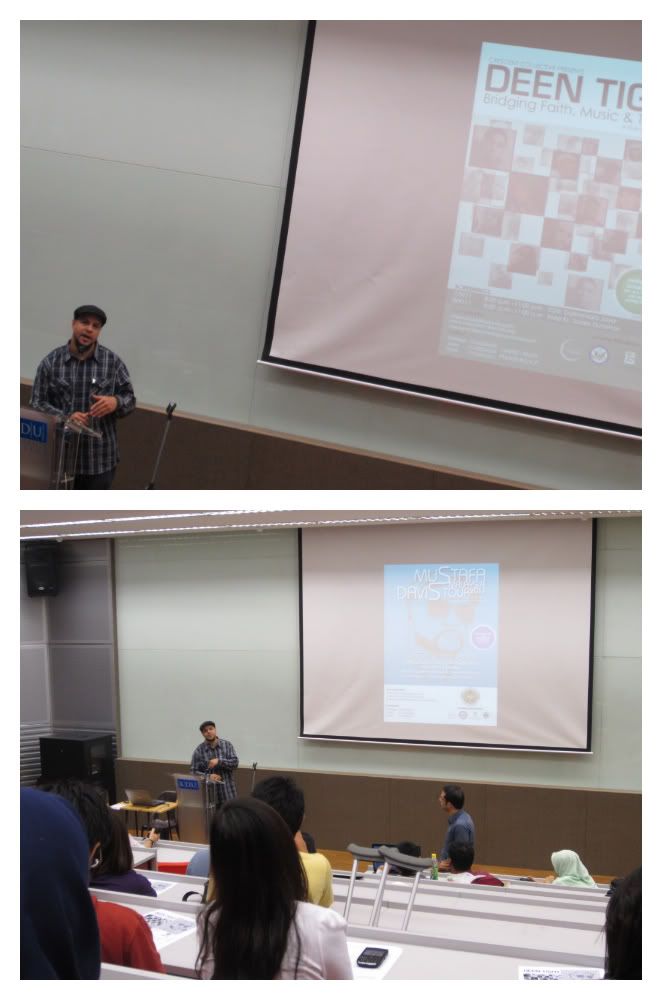
Sitting in the lecture hall reminds me of the memorable experiences during my university years. It feels good. Smiled. The event started with the screening of the film followed by Q&A with Mustafa Davis on topics related to film making and production.
www.deentight.com
Music, considered taboo practice by many traditional Muslims, has also become one of the most prominent methods for Muslims to share their faith internationally through Muslim Hip Hop. Hip Hop is a global phenomenon reaching from the skyscraper laden skies of New York all the way to the deep deserts of Arabia and beyond. It is a subculture that transcends boundaries of language, gender, and religion. Deen Tight brings to the screen the untold story of Western Muslims struggling to find a balance between their culture and their religion.
Filmed on location with Muslim rappers, DJs, slam poets, breakdancers and a graffiti artist in concerts, recording studios, at homes and in the streets. The story focuses on the perceived conflict between traditional religious ideals and modernity, as well as both the positives and negatives of Western Pop culture on todays’ Muslim youth.
Synopsis:
We follow a group of Muslim Hip Hop artists living in the United States and United Kingdom. They discuss intimately with us the challenges they face trying to balance their faith, culture, and the pressures of daily Western life.
The film provides an intimate look into the lives of a group we know very little about and how they deal with the many issues surrounding their culture and religion. Mutah Beale (formerly Napoleon of Tupac Shakur’s Outlawz) is adamant about leaving music and the Hip Hop scene as an act of obedience to God. Rapper Tyson Amir Mustafa and HBO Def Poet Amir Sulaiman see nothing wrong with using music as a form of cultural expression and DJ BelikeMuhammad even claims to use Hip Hop as a means of proselytizing his faith.
We show both sides of this conflict, through intimate and emotional scenes where the artists candidly express what motivates them to feel the way they do.
This is the tale of one of the most influential pop culture movements of our time and its relationship to Islam, one of the worlds fastest growing religions.
Struggles in bridging faith, music & tradition
The film screens different perspectives from both side: the protagonist and antagonist. Antagonist may present through phobia, interest, insecurity and community. Mustafa Davis explained that the film doesn't showcase opinion from any Muslim scholars because what they said will suppress the voices of others. Fair enough.
Here, I tried to discuss and reflect what I learned from the screening. This is merely my own personal opinion and it's in no way meant to undermine anyone. Wallahualam (Only Allah knows).
Dakwah in the new millennium
Rap, hip hop and graffiti are the language of today's youth. It's part of American lifestyle, culture and tradition. That's how the youth express their feelings, emotions and telling stories from heart to heart. They convey positive message through hip hop and rap to uplift other people and bring joy to them. To me, even when they speak a normal conversation, they sound rapping :-)

Actually, I prefer R&B and soul songs like Maher Zain's because it sounds tender, delicate and touching to the heart. Listening to the rap by Kumasi in the film make me understand how rap can also be as tender and touching as the R&B and soul. Rapping by Kumasi at the end of the film is my favorite. The wordings on submission to Allah flows through the way Kumasi rapping is just marvelous. The script was composed by Mustafa Davis himself.
Graffiti art work by Mohammed Ali has taken across the globe with his fusion of street-art and Islamic script. He describes his work as, 'taking the best of both worlds' and bridging back to the forefront principles that are gradually fading away from our modern societies. Music and arts are powerful tool to transform today's multi-cultural societies. However, vandalism is where the problem may come when youths start expressing their feelings and art work mischievously. The youths spray out bad words all over the place illegally and create unpleasant view. During my train trip from Amsterdam to Den Bosch, I could vividly see graffiti sprayed all over the place. It makes me feel a bit insecure.
Mission impossible
As a form of dakwah, some of them even take an extra steps by performing rap and hip hop at disco and clubs. They feel that they need to reach out to the people who needs the message of Allah the most - the pimps, party goers, alcoholics and the gangs. It's a risky mission though. Come to think about it, these kind of people won't go to the mosque or religious events. So, the only way the message of Allah can reach them is that we have to go to them. It reminds me of the tazkirah I recently listened to at the mosque in the month of Ramadhan. The delivery was quite stern just like how politician shouts out promises in the election campaign. I can imagine how they would respond if they listen to that. I myself prefer a gentle delivery.
I guess rap and hip hop are youthful refreshing approach. Nevertheless, some may start with the pour intention of dakwah but turn into being overzealous and then lose focus along the way. So, we've got to always reflect, remind ourselves as to who we are and what's our mission is.
Music is in their blood
Some claim that music is part of their blood. Their parents, grandparents and great great grandparents are doing this. Here, we shall treat this very carefully and learn lessons from the story of Prophet Ibrahim where he reasoning with his father and his people about their belief and practice.
Surah (Chapter) Ash -Shu’ara” (The Poets), The Quran 26:69-82
And recite to them the story of Ibrahim (Abraham)[69]
When he said to his father and his people: “What do you worship?” [70]
They said” We worship idols, and to them we are ever devoted.” [71]
He said: “Do they hear you, when you call on (them)?” [72]
“Or do they benefit you or do they harm (you)?” [73]
They said: “(Nay) but we found our fathers doing so.” [74]
He said: “Do you observe that which you have been worshipping - [75]
“You and your ancient fathers? [76]
Verily they are enemies to me, save the Lord of the 'Alamin (mankind, jinn and all that exists), [77]
“Who has created me, and it is He Who guides me. [78]
“And it is He Who feeds me and gives me to drink. [79]
“And when I am ill, it is He who cures me. [80]
“And Who will cause me to die, and then will bring me to life (again). [81]
“And Who, I hope, will forgive me my faults on the Day of Recompense, (the Day of Resurrection). [82]

Please don't get me wrong here. I'm not equating the music to worshiping other than Allah. My point here is on the gist of the story. Tradition may be good and bad. Take one example, bullfighting, it's a tradition in Spain, Portugal, southern France and some Latin American countries in which bulls are baited in the bullring for sports and entertainment. Oh yeah..it's a bloody sport, but then they regard it as a fine art. Each year, approximately 250,000 bulls died in bullfights [peta]. The point here is that we shall not merely follow the tradition without reasoning. Perhaps, we could transform the bad into good. Wallahualam (Only Allah knows).
Stay within boundaries
Contradicting opinions on faith, music and tradition may be there. I shall not make any conclusion on this matter as I'm not in the position to do so. I could understand the challenges these people face in bridging them together. It can bring benefits in some ways and can also cause harm in some other ways.
Perhaps, we could have done much better by unleashing the full potential of our mind with the guidance of Al-Quran and As-Sunnah to explore, learn, reason and understand while staying within the boundaries to the best of our ability. Wallahualam.
Other stuff: